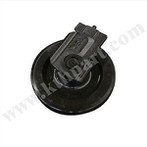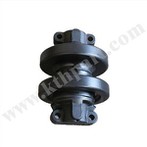


In centrifugal casting production, the working conditions of Hitachi crawler bottom rollers are very harsh, mainly because Hitachi crawler bottom rollers are often in contact with rolling materials with a temperature as high as 900~1100℃, and Hitachi crawler bottom rollers can reach 500℃. In addition to the high rolling force and the strong abrasion of the roll surface by the rolling material, the bottom roll surface of Hitachi crawler crane is prone to oxidation and the oxide film is easy to fall off under the action of high temperature. Failure of the bottom roller. In addition, the product will be repeatedly heated by the rolled material and cooled by the cooling water during work, and will be subjected to chilling and heating with a large temperature change, resulting in a large thermal stress, which will gradually lead to the generation of thermal fatigue cracks. The continuous expansion under the action of the restraining force eventually causes the surface of the product to crack or even peel off, prompting its failure.
In addition to high wear resistance and toughness, Hitachi crawler bottom rollers should also have excellent resistance to oxidation and thermal fatigue. The development and selection of materials mainly focus on improving the surface wear resistance of the product, and forming harder carbides in the metallographic structure of the product surface. With the development of hot rolling technology, product materials have been continuously improved and developed, from the early used chilled cast iron Hitachi crawler bottom rollers to semi-steel Hitachi crawler bottom rollers and high chromium cast iron Hitachi crawler bottom rollers And the bottom roller of the high-speed steel Hitachi crawler crane.